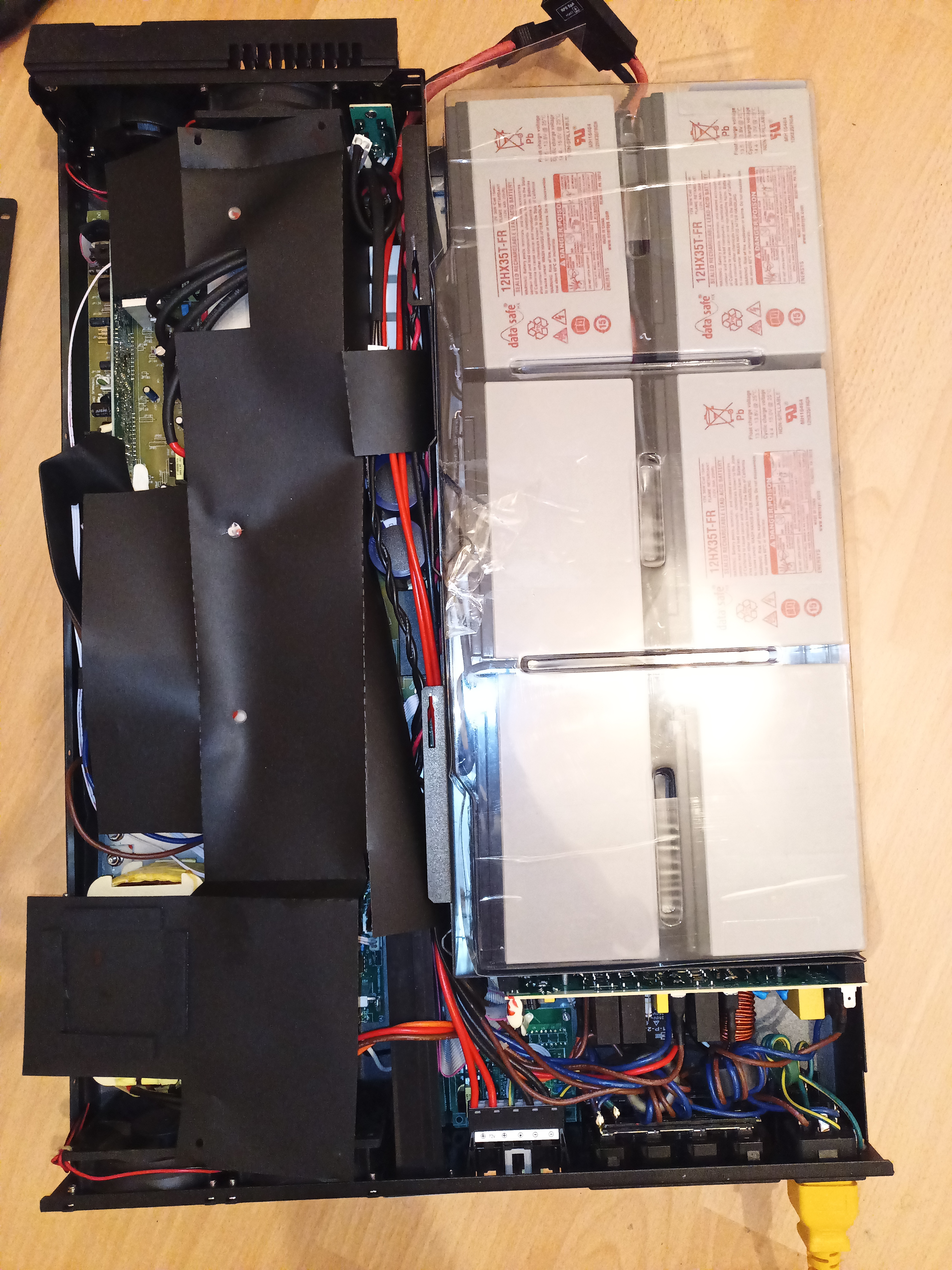
Some time ago this faulty UPS came into my hands.
The batteries in the unit were completely depleted and the UPS indicated an empty-battery error.
After installing new, fully charged batteries, the same error appeared again after a few months.
At that point the battery voltage had already dropped below the safe discharge threshold for the lead-acid batteries.
This led me to suspect that the battery charger might be faulty.
To verify this assumption, I connected partially charged batteries and measured the system battery voltage while the UPS was connected to the mains.
Since the voltage did not increase at all, it became obvious that the charging circuit was not working.
After opening the UPS, the charging connectors could be traced to a small PCB located next to the fan. On this board I tried to measure the control signals (inputs and outputs) to determine whether the control circuitry was disabling the charger, but I couldnt find a clear explanation.
As a second step, I looked up the power supply controller used on the board, which turned out to be a UC3845B current-mode controller with an integrated gate driver. When measuring its output as well as the voltage and current feedback signals, I observed some strange behaviour.
Unfortunately, I only checked the supply voltage of the controller much later. It turned out that the supply voltage was highly unstable.
The circuit topology appeared to be a resistive divider with additional auxiliary support.
After desoldering and measuring the supply capacitors, the real cause became obvious: the capacitors had failed and behaved more like resistors than capacitors.
After replacing these capacitors, the battery charger started working again, and the UPS has been operating normally ever since.
The batteries in the unit were completely depleted and the UPS indicated an empty-battery error.
After installing new, fully charged batteries, the same error appeared again after a few months.
At that point the battery voltage had already dropped below the safe discharge threshold for the lead-acid batteries.
This led me to suspect that the battery charger might be faulty.
To verify this assumption, I connected partially charged batteries and measured the system battery voltage while the UPS was connected to the mains.
Since the voltage did not increase at all, it became obvious that the charging circuit was not working.
After opening the UPS, the charging connectors could be traced to a small PCB located next to the fan. On this board I tried to measure the control signals (inputs and outputs) to determine whether the control circuitry was disabling the charger, but I couldnt find a clear explanation.
As a second step, I looked up the power supply controller used on the board, which turned out to be a UC3845B current-mode controller with an integrated gate driver. When measuring its output as well as the voltage and current feedback signals, I observed some strange behaviour.
Unfortunately, I only checked the supply voltage of the controller much later. It turned out that the supply voltage was highly unstable.
The circuit topology appeared to be a resistive divider with additional auxiliary support.
After desoldering and measuring the supply capacitors, the real cause became obvious: the capacitors had failed and behaved more like resistors than capacitors.
After replacing these capacitors, the battery charger started working again, and the UPS has been operating normally ever since.